

Muse cells are attracting scientific interest for their distinctive biological properties and their potential role in regenerative medicine. But what exactly are Muse cells, how do they differ from conventional mesenchymal stromal cells, and what does current research tell us about their potential applications?
Muse stands for multilineage-differentiating stress-enduring. These naturally occurring cells were first described by researchers at Tohoku University in Japan in 2010. Scientists have since investigated their ability to respond to signals associated with tissue damage, differentiate into different cell types, and participate in biological repair processes.
For people exploring advanced regenerative medicine, understanding Muse cells means looking beyond the headlines to examine the science, the clinical evidence, and the questions researchers are still working to answer.
At Stems For Life, in San Miguel de Allende, Mexico, we believe that informed decisions begin with clear information. Here is what you should know about Muse cells and their place in modern regenerative medicine.
What Are Muse Cells?
Muse cells are a distinctive population of cells found within certain human tissues and mesenchymal stromal cell populations. Their name describes two defining characteristics: their ability to differentiate into multiple cell types and their capacity to endure certain forms of cellular stress.
The original research, published in the Proceedings of the National Academy of Sciences in 2010, introduced Muse cells as a population with biological characteristics that set them apart from many other adult stem and stromal cells.
Researchers have identified Muse cells using specific cellular markers, including stage-specific embryonic antigen-3 (SSEA-3), together with additional characterization methods.
Three characteristics have attracted particular attention:

Stress endurance: Muse cells can survive certain stressful cellular conditions.
Multilineage differentiation: Research has demonstrated their ability to develop into cell types associated with all three major embryonic tissue lineages.
Potential tissue repair activity: Studies have investigated how Muse cells respond to signals from damaged tissue and participate in repair-related processes.
These properties make Muse cells an interesting subject of regenerative medicine research. However, their biological potential should not be confused with proof that every Muse cell product can produce a particular clinical outcome.
How Do Muse Cells Work?
Researchers are investigating several mechanisms that may explain the behavior of Muse cells.
1. Responding to signals from damaged tissue
When tissue is injured, it releases chemical signals that help coordinate the body's response. Research suggests that Muse cells can respond to certain signals associated with tissue damage.
One pathway under investigation involves sphingosine-1-phosphate, a signaling molecule associated with the movement of Muse cells toward injured areas. This process is often described as cellular homing.
Much of the mechanistic evidence comes from laboratory and preclinical studies. The extent to which these processes occur with different cell products in human patients requires further investigation.
2. Differentiating into different cell types
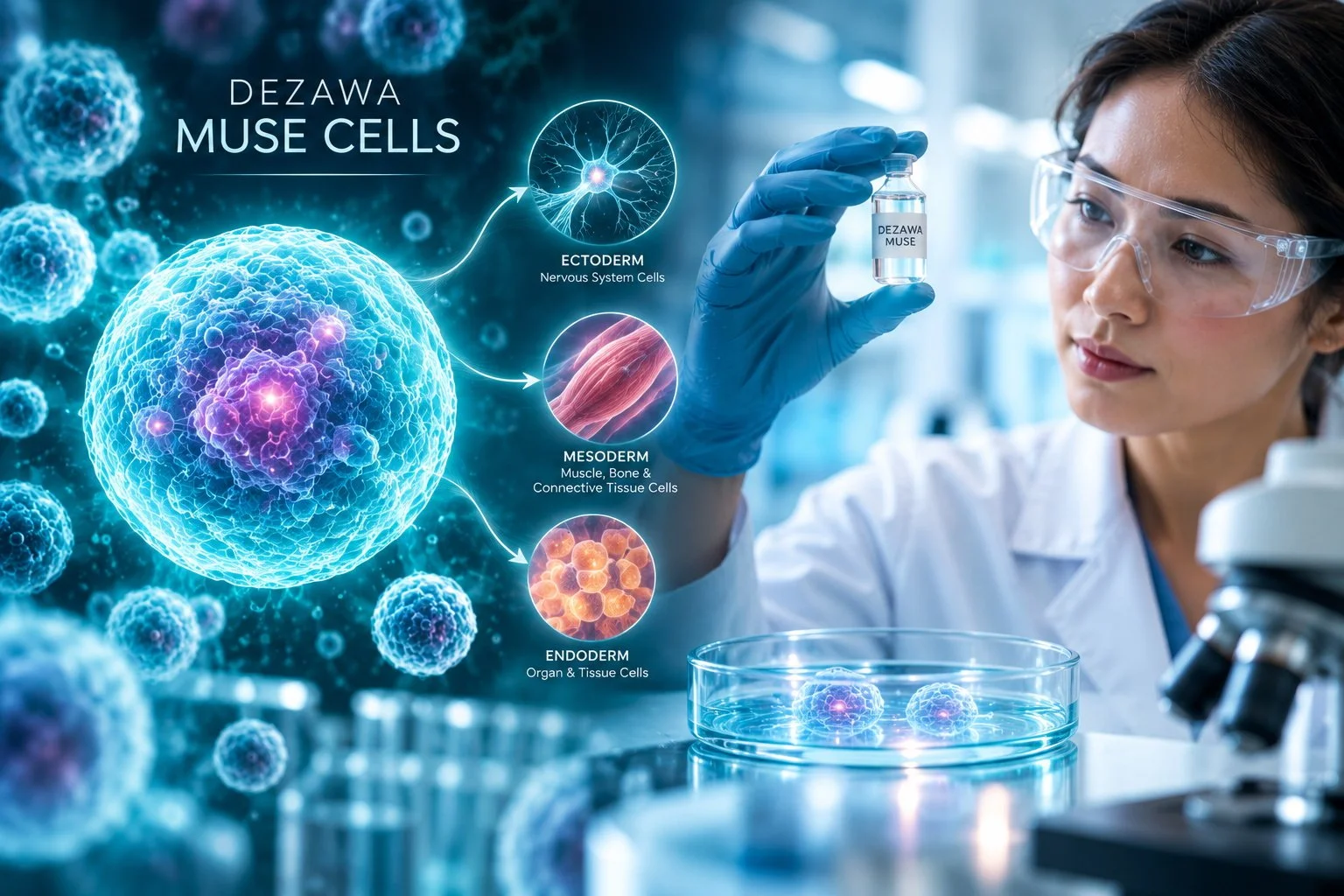
Muse cells have demonstrated the ability to differentiate into cell types associated with the three major embryonic tissue lineages:
Ectoderm, which includes cell types associated with the nervous system.
Mesoderm, which includes cell types associated with muscle, bone, and connective tissues.
Endoderm, which includes cell types associated with organs such as the liver and lungs.
This broad differentiation capacity is one reason researchers are investigating Muse cells for potential applications involving different tissues.
However, the ability to produce cells with particular characteristics in experimental settings does not automatically mean that a treatment can regenerate a complete organ or restore its function.
3. Interacting with the surrounding cellular environment
Muse cells are also being studied for their interactions with surrounding cells and biological signaling pathways.
Researchers are exploring whether these interactions may influence inflammation, cell survival, and tissue repair. The relative importance of these mechanisms may vary according to the type of injury, the cell preparation, and the treatment approach.
Understanding these mechanisms is an important step toward determining where Muse cell-based approaches might eventually have a meaningful clinical role.
Muse Cells vs. Mesenchymal Stem Cells: What Is the Difference?
Mesenchymal stem cells, commonly called MSCs, are among the most extensively studied cell populations in regenerative medicine. Muse cells are particularly interesting because they represent a distinctive population that can occur within certain mesenchymal stromal cell preparations.
Mesenchymal Stromal Cells (MSCs)
Cell identity: A diverse population of stromal cells.
Differentiation: Studied for bone, cartilage, and fat formation.
Stress resistance: Varies among cell populations.
Research focus: Immunomodulation and tissue support.
Muse Cells
Cell identity: A distinct cell population with specific markers and functional properties.
Differentiation: Studied for their potential to develop into multiple cell types.
Stress resistance: Notable for their ability to survive certain cellular stress conditions.
Research focus: Stress resistance, differentiation, and potential tissue repair.
The distinction matters because a product described as containing mesenchymal stromal cells is not automatically a specifically characterized Muse cell product.
Likewise, using the term Muse cells in marketing materials does not independently establish the identity, purity, or biological characteristics of a particular preparation. Product-specific documentation and quality testing remain important.
What Does Research Say About Muse Cell Therapy?
Muse cell research has progressed from laboratory experiments to early-stage human clinical studies in selected medical conditions.
Researchers have investigated applications involving neurological injury, cardiovascular conditions, and certain skin disorders. The available evidence varies by condition and study design.
Muse cells and neurological research
One area of investigation involves ischemic stroke, which occurs when blood flow to part of the brain is interrupted.
A randomized study published in 2023 examined an investigational Muse cell product, CL2020, in patients with subacute ischemic stroke. The study included 35 participants: 25 received the cell product and 10 received placebo.
The investigators reported differences in functional outcomes between the groups. Although these findings are scientifically interesting, the study was relatively small and requires confirmation in larger trials.
Other research has examined Muse cells in spinal cord injury and amyotrophic lateral sclerosis (ALS). These studies have generally involved small patient groups, making it difficult to draw firm conclusions about effectiveness.
Muse cells and cardiovascular research
Researchers have also investigated Muse cells in the context of heart injury.
An early human study involving three patients with acute myocardial infarction examined the administration of an investigational allogeneic Muse cell product. Improvements in certain measures of cardiac function were reported during follow-up.
Because the study was very small, the findings cannot establish that Muse cells are an effective treatment for heart disease. Larger controlled studies are needed to determine whether the observed changes represent a reproducible treatment effect.
What can we conclude from the research?
The scientific findings provide reasons to continue investigating Muse cells, but they do not establish that all products marketed under the Muse name are equivalent.
The results of a study depend on the product used, its manufacturing process, the patient population, the treatment protocol, and the condition being investigated.
A 2025 review of mesenchymal stromal cell subpopulations emphasized the need for stronger characterization, reproducible manufacturing methods, and larger clinical studies before the therapeutic advantages of specific cell populations can be fully established.
For patients, the most useful question is therefore not simply whether Muse cells have been studied, but whether reliable evidence supports the specific product and proposed treatment under consideration.
What Are DEZAWA MUSE Cells?
The name Muse cells is associated with the research of Professor Mari Dezawa and her collaborators at Tohoku University in Japan.
DEZAWA MUSE is a commercial designation associated with a particular Muse cell technology. When evaluating a product marketed under this name, it is important to distinguish the scientific literature about Muse cells generally from the documentation and evidence applicable to the specific product.
Patients should seek information about:
The identity and source of the cells.
Product-specific characterization and quality-control testing.
The laboratory responsible for preparation and release.
Applicable regulatory documentation and the intended use of the product.
Clinical evidence relevant to the condition being considered.
Research involving one Muse cell product should not automatically be treated as evidence for another preparation.
To learn more about the approach presented by Stems For Life, visit our dedicated DEZAWA MUSE Cell Therapy page.
Are Muse Cells Safe?
Safety is an essential consideration in any cell-based treatment.
Preclinical research has investigated the tumor-forming potential and other biological characteristics of Muse cells. Early clinical studies have also reported safety observations in specific patient populations.
However, small studies cannot reliably identify rare complications or establish long-term safety across different products and medical indications.
Important factors to consider include cell identity, donor screening where applicable, manufacturing controls, sterility, viability, administration procedures, and appropriate medical follow-up.
Patients should ask about the specific product being offered rather than relying solely on general statements about Muse cells as a biological category.
A qualified physician should discuss the available evidence, possible risks, uncertainties, alternatives, and suitability of any proposed treatment.
Exploring Muse Cell Therapy in Mexico
People researching regenerative medicine may consider treatment options outside their home country. Mexico is one destination for international patients exploring private medical services.
When evaluating a treatment abroad, it is important to consider more than the location or advertised benefits. Patients should understand the medical oversight, laboratory documentation, applicable regulatory requirements, and follow-up arrangements associated with the specific intervention.
Stems For Life offers a personalized regenerative medicine concierge experience in San Miguel de Allende, Mexico. We help patients explore available options and coordinate their experience with medical professionals.
Our approach emphasizes individual medical assessment rather than a one-size-fits-all treatment package. Any recommendation about treatment suitability should be made by the responsible qualified physician after reviewing the patient's circumstances.
Learn more about stem cell therapy in Mexico and the personalized services available through Stems For Life.
Frequently Asked Questions About Muse Cells
What does Muse stand for?
Muse stands for multilineage-differentiating stress-enduring. The term describes a population of cells investigated for their ability to tolerate certain cellular stresses and differentiate into multiple cell types.
How are Muse cells different from regular stem cells?
Muse cells have a distinctive biological profile, including stress endurance and multilineage differentiation. They are a particular cell population, not a general term for all stem cells.
Has Muse cell therapy been studied in humans?
Yes. Early human studies have investigated specific Muse cell products in conditions including ischemic stroke, myocardial infarction, spinal cord injury, and other medical conditions. The amount and strength of evidence differ by indication, and larger studies are needed to establish effectiveness.
Are all Muse cell products the same?
No. Products can differ in cellular composition, characterization, manufacturing, quality controls, and supporting clinical evidence. The identity of a specific product should be established through appropriate documentation.
Is Muse cell therapy suitable for everyone?
No cell-based treatment is suitable for everyone. Individual suitability depends on the person's medical history, diagnosis, current care, and the evidence supporting the proposed intervention. A qualified physician should assess these factors before treatment.
Where can I learn more about DEZAWA MUSE Cell Therapy?
You can explore the DEZAWA MUSE Cell Therapy page at Stems For Life or request a consultation to discuss your questions.
Explore Your Regenerative Medicine Options
Muse cells represent an intriguing area of scientific research. Their distinctive properties have generated interest in tissue repair and regenerative medicine, but important questions about clinical effectiveness, product-specific characteristics, and long-term safety remain.
Understanding both the research and its limitations is an important part of making informed medical decisions.
At Stems For Life, we help international patients explore personalized regenerative medicine options in San Miguel de Allende, Mexico, with an emphasis on individualized medical assessment and informed decision-making.
Visit Stems For Life to learn more.
Scientific References
Kuroda Y, et al. Unique multipotent cells in adult human mesenchymal cell populations. Proceedings of the National Academy of Sciences, 2010. Find the original research on PubMed.
Niizuma K, et al. Phase 2 trial of intravenous administration of allogeneic multilineage-differentiating stress-enduring cells in patients with subacute ischemic stroke. Find the clinical study on PubMed.
Koda M, et al. Safety and feasibility of intravenous administration of a single dose of allogenic-Muse cells to treat human cervical traumatic spinal cord injury: a clinical trial. Stem Cell Research & Therapy, 2024. Read the study.
Pearl JR, et al. Hierarchical therapeutic potential in the mesenchymal stem cell landscape. Journal of Translational Medicine, 2025. Read the review.
Educational information only; this article does not constitute medical advice or a recommendation to undergo treatment. Clinical evidence and regulatory status should be evaluated for the specific product and intended use.
